

Energin emails commercial and industrial market customers a Monthly Electricity Summary Report.
We designed this report to explain how electricity invoices are computed by showing key information such as monthly and daily usage and costs, allowing businesses to manage and control how they use their electricity and plan their budget.
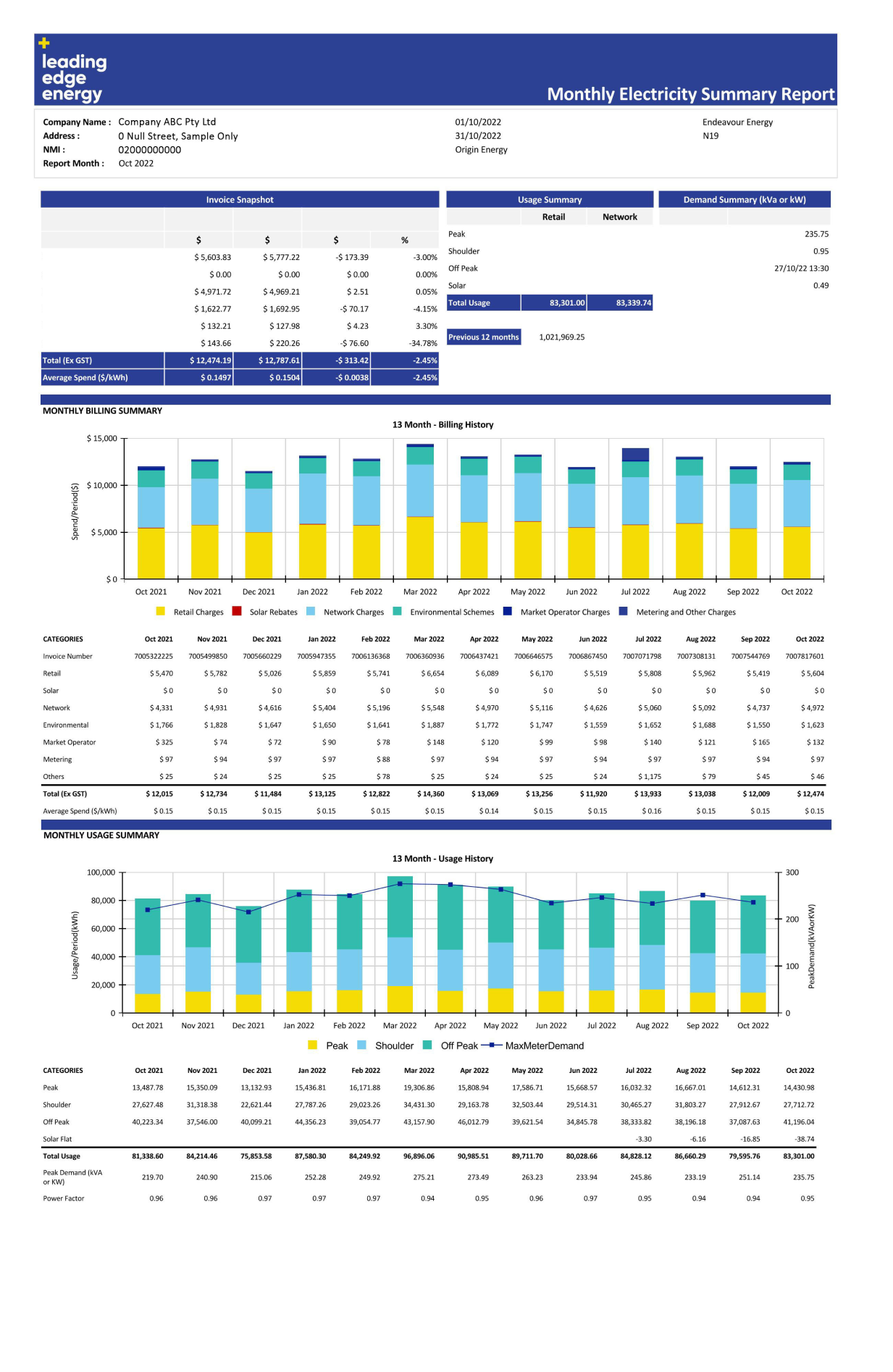
BASIC INFO:
- Billing Start –The beginning of the billing period for the month.
- Billing End – The last day of the billing period for the month.
- Retailer – The company that sells electricity to end-consumers. Energin has a list of energy retailer partners here.
- Network – The company that distributes electricity from the grid to end-users.
- Tariff – A code assigned by the network that signifies how the customer is charged for using electricity network infrastructure.
INVOICE SNAPSHOT:
- Retail Charges – The cost of electricity consumed by the business as set by the retailer.
- Solar Rebate – This is an incentive given to businesses that have solar energy systems installed on their sites by approved retailers.
- Network Charges – Also known as supply charges, these fixed, regulated rates are the cost of maintaining, building, and operating the network infrastructure to supply power to consumers.
- Environmental Schemes – These are costs incurred by retailers as they comply with the requirements of the Renewable Energy Target and are passed on to the consumer.
- Market Operator Charges – These fees are charged by the AEMO to recover the costs of regulating the market and prevent further volatility. These include AEMO ancillary fees, Unaccounted for Energy, and RERT events.
- Metering and Other charges – These are fees paid to the metering service providers when a request is put in for changing, removing, or installing an electricity meter. This depends on the service requested. Other charges that may be included here are:
- Current billing period – The current or billing period.
- Average of Invoices – The average charges from the most recent 13 months.
- Movement – The difference between the invoice average and the current invoice.
USAGE SUMMARY:
RETAIL (kWh)
- Retail Peak – This is the volume of electricity used by the business during periods of high demand (when it’s most expensive).
- Retail Shoulder – This is the volume of electricity used by the customer between Peak and Off-peak periods.
- Retail Off-peak – This is how much electricity the customer uses when demand is at its lowest – typically at night and during weekends.
- Retail Solar – This is how much the customer used solar energy during the billing period.
NETWORK (kWh)
- Network Peak – This is the network’s electricity usage during peak times charged by the network. This can typically be managed by keeping actual usage below the levels agreed-upon with the distributor.
- Network Shoulder – This is how much the network charges the customer for using electricity during shoulder periods (the time between peak and off-peak).
- Network Off-peak – This is how the network charged the customer for using electricity when demand is lowest.
DEMAND SUMMARY (in kVa or kW):
- Peak Demand – This is the highest demand reached during the time period. This especially impacts Time-of-Use pricing.
- Power Factor – This is the measure of a location’s energy efficiency and is typically shown as a percentage. If the value is lower, that means the power usage is not very efficient.
- Load Factor – Load factor measures how efficiently the customer’s site uses electricity. Knowing this helps consumers save money if they’re able to adjust their usage during peak periods.
As an Energin client, we’re dedicated to helping you find smart, sustainable solutions to save your business money on energy and start on the path to energy efficiency and carbon reduction. One way we do this is by sending you an Electricity Summary Report each month to give you a better understanding of your business’ electricity consumption and costs for the past 13 months.
This page is a companion guide to our Monthly Electricity Summary Report so you can more clearly see what the different parts of the report are and why the data we show matters if you want to meet your business’ energy cost efficiency and sustainability goals.
Not yet an Energin client? Want to find opportunities to save on your business’ commercial or industrial energy bills?
